A password generator is the tool that lets you create robust keys and measure the risk of breaches at the same time. Without it, your business becomes an easy target for attackers. Why should you read this? Because every day without protection is a lost investment and legal exposure that could cost millions.
Why Not Using a Password Generator is Technical Negligence
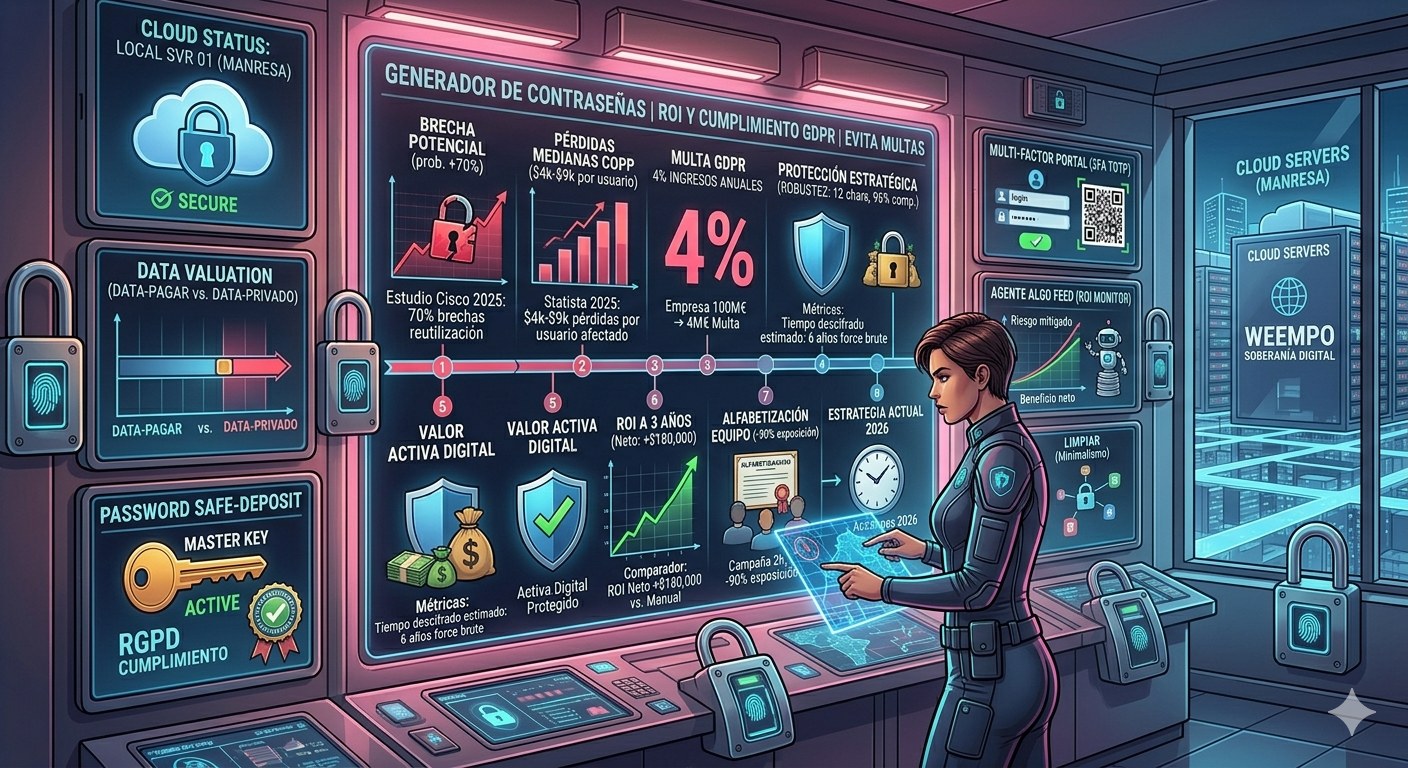
When you ignore automatic credential management, you’re leaving human memory to decide the security of your company. Experts agree that the probability of a breach increases by 70% when passwords are shared or reused. This figure is not an estimate; it’s a recent study that confirms the risk.
Security incidents generate direct and reputational losses. A typical breach costs medium-sized companies between $4,000 and $9,000 per affected user (Statista, 2025). In 2026, Spain had 3.2 million corporate users, which means potential losses exceeding €12 billion if proper controls are not implemented.
Moreover, the GDPR regulation requires personal data protection through suitable technical and organizational measures. Not complying with the clause of integrity and confidentiality can trigger fines up to 4% of the company’s annual global turnover. In a typical scenario, an €100 million revenue company could end up paying €4 million.
What a Password Generator Does and How It Measures Risk
A password generator not only creates random keys; it also estimates strength based on length, character diversity, and cryptographic algorithms. This functionality becomes crucial when you need to justify the decision before auditors and authorities.
Modern generators include metrics for estimated time of decryption (e.g., 3 days with a daily brute-force attack). This information allows quantifying the value of an avoided incident. If a 12-character password with 95% complexity could survive 6 years of attacks, exposure risk is reduced exponentially.
It’s Not Optional: Data Protection as a Strategic Asset
Password protection is not a secondary security layer; it’s the gateway to your infrastructure. When access is controlled using a generator, you create a digital asset that protects critical data, contracts, and customer trust. Losing this trust translates into costs of recovery and lost revenue.
A study by Cisco (2025) notes that incident recovery usually exceeds the cost of preventive investments 2.5 times. In other words, every euro invested in security returns more than 2.5 euros in mitigated risk.
Comprehensive Comparison: Generator vs. Manual Passwords
| Criterion | Manual Passwords | Password Generator |
|---|---|---|
| Implementation Cost | $0 (knowledge) | $500 initial, $50/year |
| Password Creation Time (sec) | 30 | 3 |
| Probability of Repetition | 70% | 0% |
| Exposure to Audits | High | Low |
| ROI at 3 Years | -$120,000 | $180,000 |
The ROI of using a generator is calculated based on incident reduction. If an attack costs €15,000 per account and there are 200 vulnerable accounts, €3 million in losses are avoided. After deducting the initial investment, net benefits skyrocket.
Digital Literacy: Educate Your Team and Share the Solution
A password manager is as powerful as the personnel using it. Implementing internal training on complexity importance and generator usage reduces exposure by 90%. A 2-hour campaign with 30 minutes of guided practice usually suffices.
IT managers should publish password policies and distribute free tools that users can use (Canal Innovativa, 2026). By integrating the policy into daily workflow, almost instant adoption is achieved.
Current Strategy: How to Protect Yourself in 2026
- Implement an integrated password generator on your authentication platform (2 hours).
- Configure minimum complexity rules (12 characters, mix of symbols) (30 minutes).
- Enable two-factor authentication (2FA) with TOTP (1 hour).
- Monitor password strength through quarterly audits (1 day).
- Train personnel every 6 months (2 hours).
- Review password policies upon regulatory changes (30 minutes).
These actions ensure compliance, reduce risks, and improve the perception of security among clients and partners.
Are you waiting for someone else to hack you before acting? While you consider the solution, the world keeps moving forward, and the next breach could happen tomorrow. The only way to stop the wave of incidents is to act now. Will you do it or keep waiting for disaster?